Qyvandra
Pulse Guide
Pulse Guide
Couldn't load pickup availability
1. Problem Statement
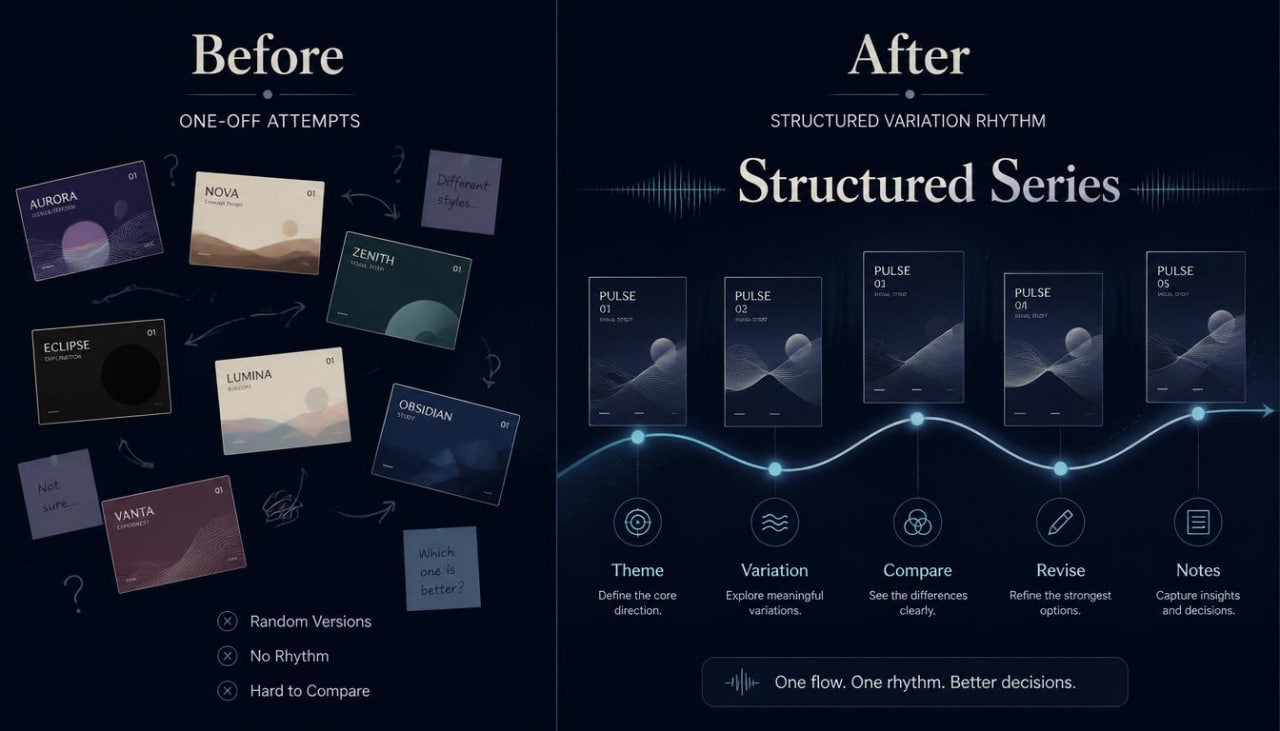
When a designer already understands basic AI-based approaches and can create a structured description, the next challenge appears: how to work with a full series instead of one variation. The first idea may feel interesting, but without analysis it can be difficult to understand whether it can be developed, refined, or shown through another mood. The design process may stop at random results when the learner does not have a system for comparing, sorting, and editing variations. Another question also appears: how to keep several pieces cohesive so they feel like part of one direction rather than a group of unrelated images. This is why a learning block is needed to explain the rhythm of creative work: from the first description to a series of carefully reviewed variations.
2. Solution
Pulse Guide is created for developing consistent practice in AI-based design work. This tier shows how to build idea series, set repeated visual parameters, and track changes between different variations. The materials help the learner work with rhythm: main idea, several directions, comparison, clarification, another edit, and a final learning note. In this block, the learner does not only create separate descriptions, but guides a design task through several connected steps. This format helps learners understand their own choices, notice repeated mistakes, and prepare more cohesive creative materials.
3. What’s Inside
Pulse Guide includes modules devoted to rhythm, repetition, and analysis of serial design choices. The first section explains the idea of a creative pulse. The learner studies how one central idea can have several visual forms: through color, composition, shape, scale, texture, space, or mood. This section shows how to keep a connection between variations, even when their presentation differs.
The second section focuses on serial descriptions. The learner practices creating not one prompt, but a group of related descriptions. For example, one theme can be presented through a calm geometric composition, a soft illustrative approach, contrast-based typographic logic, or an abstract visual direction. Each description has a shared base, but receives separate details that change the character of the work.
The third section explores control of repeated elements. A design series feels cohesive when it has shared traits: a similar palette, the same type of space, repeated rhythm of shapes, a close mood, or a stable composition structure. The learner studies how to define these traits at the beginning of the process and carry them into different tasks. This helps keep the main idea from getting lost during variation practice.
The fourth section contains comparison exercises. The learner takes three or four variations of one idea and evaluates them through several criteria: readability, cohesion, mood match, detail balance, clarity of the main accent, color use, and sense of space. This type of analysis helps learners view visual materials not only emotionally, but also structurally.
The fifth section focuses on editing series. The learner studies how to see what needs to change: reduce the number of details, clarify tone, change scale, strengthen the accent, remove extra elements, or rewrite the description. In this module, the key is not only to correct one variation, but to understand how a revision affects the whole series. For example, when the palette becomes warmer in one description, it is useful to check whether this changes the general direction.
The sixth section contains the exercise “one idea — five presentations.” The learner chooses a theme, writes its main thought, defines visual boundaries, and creates five descriptions with different accents. Then the learner compares them, chooses one or two stronger directions for further study, and explains why these variations feel more cohesive.
The seventh section is a working map for a series. It contains fields for the theme, shared traits, variable parameters, color logic, composition structure, comparison criteria, and notes after editing. This map helps the learner stay oriented between variations and see the whole process on one page.
The eighth section explains how to prepare a note after the exercise. The learner practices briefly describing what worked in the series, which elements need review, which words in the description created clearer visual logic, and which ones added unnecessary complexity. This note turns practice into learning material that can be revisited during future tasks.
4. Who Is This For?
Pulse Guide is suitable for learners who already have a basic understanding of AI-based design and want to study how to work with several variations of one idea. This tier is useful for designers creating visual series, branding concepts, mood directions, illustrative sets, composition studies, or training design sketches. It also fits learners who often get lost among many variations and want a clear system for evaluation, selection, and editing. The materials are not tied to specific services. The main focus is thinking, structure, analysis, and repeated creative actions.
5. What You’ll Learn
- How to build a series of design ideas from one theme.
- How to create several related descriptions while keeping the main logic.
- How to define shared traits for a visual series.
- How to change style, mood, composition, and color within one direction.
- How to compare variations using clear criteria.
- How to edit not only one description, but a whole set of materials.
- How to notice repeated mistakes in the creative process.
- How to create a working map for a serial design task.
- How to write a short learning note after an exercise.
- How to prepare for more detailed Qyvandra modules where longer concept work matters.
6. Purchase Terms
Pulse Guide includes a 30-day refund option according to the store terms. The learner can review the materials, study the tier structure, and submit a refund request within the defined period if the format does not match their learning needs. Qyvandra presents this tier as a learning course for skill development, analysis of serial choices, and better organization of creative practice. We do not use inflated claims, pressure-based wording, or state the same outcomes for every learner. The materials are intended for careful study, independent practice, and consistent work with AI-based approaches in design.
Self-paced learning overview
- 📁 Digital file available after purchase
- 🗂️ Long-term availability
- 🔒 Secure checkout
- 🗓️ Content updated in 2026
Are the courses suitable for beginners in design and AI?
Are the courses suitable for beginners in design and AI?
Yes, the materials are built step by step. Each tier has its own depth, so learners can start with basic topics and gradually move toward more detailed tasks.
Do I need technical background?
Do I need technical background?
No, the focus is on design thinking, idea development, composition, visual logic, and AI-based approaches without naming specific programs.
Can I study at my own pace?
Can I study at my own pace?
Yes, the materials are created for independent learning. You can return to topics, exercises, and examples whenever it suits your study rhythm.
Share