Qyvandra
Frame Module
Frame Module
Couldn't load pickup availability
1. Problem Statement
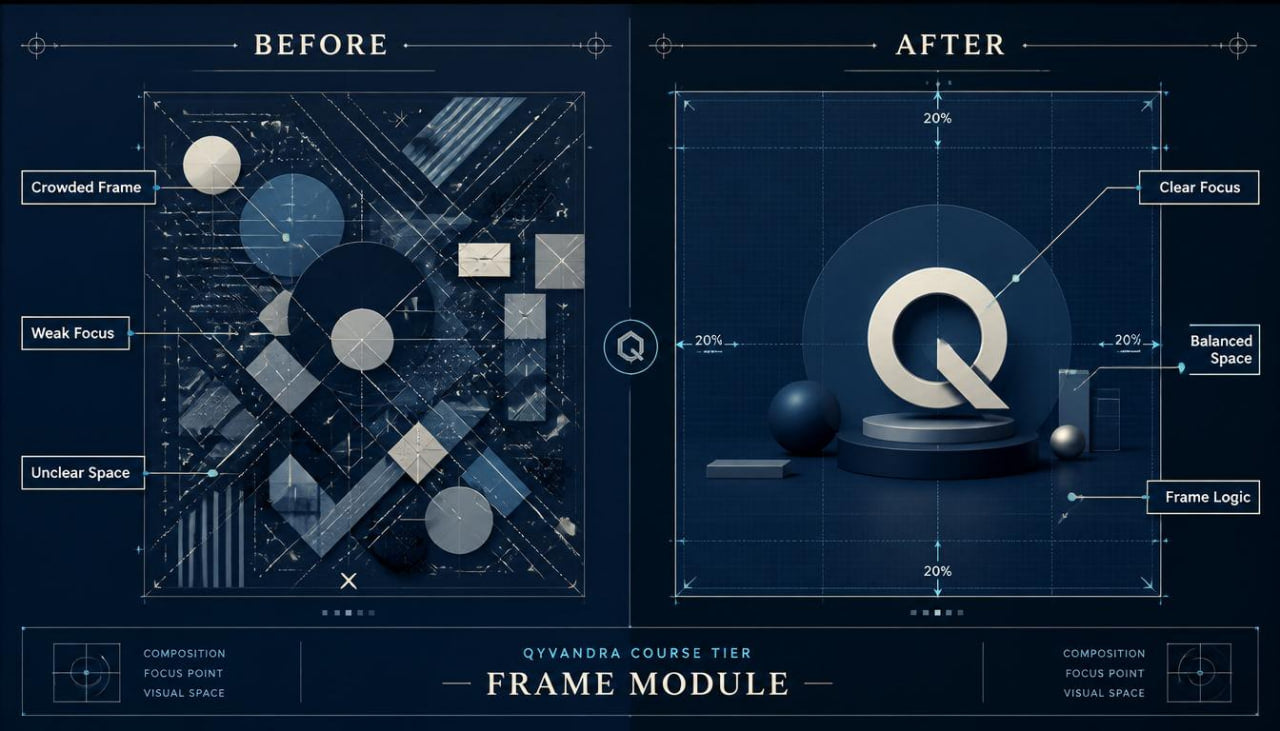
After working with separate ideas and series of variations, a designer often faces the question of composition. Even an interesting theme may look weak if it does not have a clear focus point, spatial logic, and thoughtful placement of elements. AI-based approaches can create many different variations, but without composition analysis, it can be difficult to understand why one piece reads better while another feels overloaded. Often the issue is not the idea itself, but how it is placed inside the frame. At this stage, it becomes important to study design as a system of boundaries, accents, proportions, and visual pauses.
2. Solution
Frame Module helps the learner work with composition in a more deliberate way. This tier explains how to build a frame around the main idea, how to define the central accent, and how to guide the space between elements. The materials show how to describe composition in words so an AI task has clear visual direction. The learner practices analyzing balance, scale, rhythm, empty space, tension, and reading order. Because of this, design tasks become more cohesive, and work with visual variations becomes more structured.
3. What’s Inside
Frame Module includes modules devoted to frame building and composition logic. The first section explains what a frame means in design thinking. It is not only the physical boundary of an image, but the space where an idea receives shape. The learner studies how boundaries influence perception: what happens when an object stands in the center, when it shifts to the side, when there is a lot of air around it, or when the composition becomes dense.
The second section focuses on the point of attention. The learner studies how to define the main element in a visual piece and how to support it with other details. The materials explain the difference between a strong accent and random overload. For example, a large object in the center does not always work better than a smaller element with precise contrast, proper spacing, and a clear direction for the viewer’s eye.
The third section explores empty space. In design, a pause can be as important as shape or color. The learner practices describing space in tasks: open, dense, airy, symmetrical, shifted, deep, or flat. This block helps explain how space affects mood, readability, and overall composition tension.
The fourth section focuses on proportions and scale. The learner studies how the size of elements changes the feeling of the whole piece. A large object can create drama, small details can form a textural rhythm, and scale contrast can direct attention. In the exercises, the learner takes one idea and presents it through different scales: a large central object, a group of small details, a simple geometric scheme, or an asymmetrical placement.
The fifth section explains composition rhythm. Rhythm appears when elements repeat, alternate, or move the eye in a certain direction. The learner studies lines, blocks, repetitions, pauses, and visual transitions. The materials show how to describe rhythm in a written task: through repeated shapes, movement direction, element density, contrast between light and dark, or gradual scale change.
The sixth section focuses on composition analysis of results. The learner receives an evaluation scheme: where the focus point is placed, how visual weight is distributed, whether there are extra details, whether there is enough space, whether the reading order is clear, and whether the background supports the main idea. This approach helps revise not by “like / dislike,” but by specific parameters.
The seventh section contains the exercise “one idea — three frames.” The learner chooses a theme and creates three composition choices: central, asymmetrical, and spatial. Then the learner compares them through criteria: focus, balance, rhythm, depth, tension, and readability. The exercise shows how one idea can change its character only through different element placement.
The eighth section is a composition brief template. The learner fills in fields such as main idea, point of attention, frame boundaries, space type, scale, rhythm, background, secondary elements, details to avoid, and evaluation criteria. This template helps create more thoughtful AI tasks and better understand personal composition choices.
4. Who Is This For?
Frame Module is suitable for learners who already know how to write basic AI tasks and want to work more carefully with composition. This tier is useful for designers, illustrators, visual concept creators, creative students, and anyone working with frame, space, shape, and visual balance. It also fits learners who often see an interesting idea but do not understand why the composition feels weak or overloaded. The materials are not tied to specific programs or services. The main focus is learning to see structure inside the frame and describe it in words.
5. What You’ll Learn
- How to define the focus point in a visual piece.
- How to describe frame boundaries for an AI task.
- How to work with empty space, balance, and proportions.
- How to change the character of an idea through scale.
- How to create composition rhythm through repetitions, pauses, and direction.
- How to compare central, asymmetrical, and spatial composition.
- How to evaluate a result by focus, weight, depth, and readability.
- How to remove extra details from the frame.
- How to write a composition brief for a creative task.
- How to prepare for later Qyvandra tiers where concept work becomes deeper.
6. Purchase Terms
Frame Module includes a 30-day refund option according to the store terms. The learner can review the materials, study the tier structure, and submit a refund request within the defined period if the format does not match their learning needs. Qyvandra presents this tier as a learning course for developing composition thinking, frame analysis, and practice with AI-based approaches in design. We do not use inflated claims, pressure-based wording, or state the same outcomes for every learner. The materials are intended for careful study, independent practice, and better organization of creative work.
Self-paced learning overview
- 📁 Digital file available after purchase
- 🗂️ Long-term availability
- 🔒 Secure checkout
- 🗓️ Content updated in 2026
Are the courses suitable for beginners in design and AI?
Are the courses suitable for beginners in design and AI?
Yes, the materials are built step by step. Each tier has its own depth, so learners can start with basic topics and gradually move toward more detailed tasks.
Do I need technical background?
Do I need technical background?
No, the focus is on design thinking, idea development, composition, visual logic, and AI-based approaches without naming specific programs.
Can I study at my own pace?
Can I study at my own pace?
Yes, the materials are created for independent learning. You can return to topics, exercises, and examples whenever it suits your study rhythm.
Share