Qyvandra
Axis Set
Axis Set
Couldn't load pickup availability
1. Problem Statement
After the first introduction to AI, many designers face a new challenge: they understand the basic terms, but they do not yet have a stable work system. Ideas may appear in a scattered way, descriptions may feel uneven, and results can be difficult to compare. A clear logic is often missing: how to move from an initial idea to a shaped visual direction without losing personal vision. A designer may have an interesting thought but may not know how to divide it into style, shape, mood, composition, and purpose. Because of this, the learning process needs not only exercises, but also a clear structure that helps organize creative choices.
2. Solution
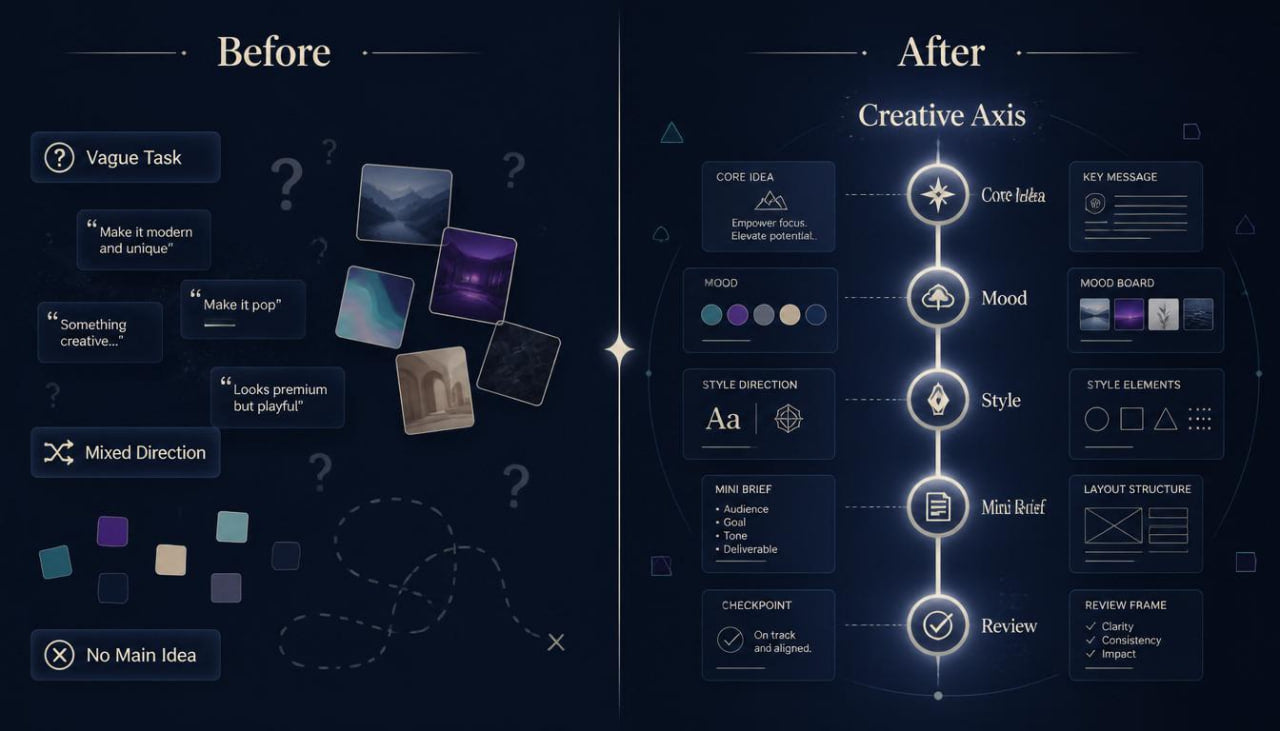
Axis Set helps build a foundation for consistent AI-based design work. The tier explains how to form a central idea, describe it through visual characteristics, and keep one logic across several variations. The materials guide learners through examples, exercises, and analysis so they do not simply repeat a template, but understand the reason behind each step. Special attention is given to the connection between a written description and the future visual direction. As a result, the learner receives a practical way to organize ideas, compare directions, and prepare more cohesive creative tasks.
3. What’s Inside
Axis Set includes materials that help learners move from basic orientation to a more conscious design process. The first section focuses on the idea of a creative axis. The learner studies how to define the main idea of a future piece, which details support that idea, and which details create unnecessary noise. This block explains why every design direction needs an inner center: a theme, mood, visual rhythm, or specific message.
The second section explores the structure of a design description. Here, the learner works with elements such as purpose, audience, style, tone, composition, palette, shape, material feel, space, and visual tension. The materials show how these parts influence each other. For example, a minimal style needs a different rhythm of details than a dense illustrative approach. A calm mood requires different color choices than a dynamic promotional composition.
The third section is devoted to prompt logic without scattered wording. The learner practices building a description not as a random set of words, but as a mini brief. In this brief, every part has a role: one explains the theme, another sets the style, another describes the composition, another clarifies the mood, and another defines the boundaries of the future work. This approach helps learners guide the idea more clearly and see where the description needs editing.
The fourth section contains practice with visual directions. The learner takes one idea and creates several ways to present it: calm, contrast-based, geometric, soft, detailed, or abstract. After that, the learner compares the variations by criteria: whether the main thought remains clear, whether the composition is overloaded, whether the palette supports the mood, whether the shape is readable, and whether the elements work together. This practice helps learners think in directions rather than isolated images.
The fifth section explains how to work with references. In Axis Set, a reference is not treated as something to copy, but as a source for analysis. The learner studies how to separate a reference into components: structure, light, rhythm, texture, color, scale, empty space, and accent. Then these observations are turned into a personal description that supports a new idea.
The sixth section focuses on revision. Here, the learner sees how to edit a description after the first result. If the composition is too crowded, the description can be simplified. If the mood feels unclear, the atmosphere can be clarified. If the style is too vague, formal traits can be added: line type, contrast, texture, proportions. This block teaches learners to view the result as part of the process, not as the final answer.
The seventh section contains a working template for creating a personal creative axis. The learner fills in fields such as main idea, mood, visual traits, composition center, color logic, reference observations, boundaries, and evaluation criteria. This template can be used for training exercises, personal sketches, concepts, visual series, and preparation for more detailed Qyvandra tiers.
4. Who Is This For?
Axis Set is suitable for learners who have completed the introductory block or already have a basic understanding of AI in design, but want a more organized way to work. This tier is useful for beginner designers, creative students, visual concept creators, illustrators, brand designers, and anyone working with sketches, mood directions, or visual ideas. The materials are helpful for those who find it difficult to describe an idea in words, compare several variations, or keep one logic between the idea and its visual presentation. The tier is not tied to specific programs or services. The main focus is learning how to see structure inside the creative process and work with AI as a tool for analysis, variation, and organizing thoughts.
5. What You’ll Learn
- How to define the central idea of a design task.
- How to build a creative axis for future visual work.
- How to describe style, mood, composition, color, and shape.
- How to turn a broad thought into a structured mini brief.
- How to create several visual directions from one idea.
- How to analyze references through structure, rhythm, texture, and accents.
- How to compare variations using clear criteria.
- How to revise a description after the first result.
- How to remove unnecessary noise from a creative task.
- How to prepare more precise materials for later Qyvandra modules.
6. Purchase Terms
Axis Set includes a 30-day refund option according to the store terms. This means the learner can review the materials, study the tier structure, and decide whether the format matches their learning needs. Qyvandra describes this tier as a learning course for skill development, careful analysis, and consistent work with design tasks. We do not use inflated claims, pressure-based wording, or statements about specific personal outcomes. The materials are intended for practice, study, and better organization of the creative process.
Self-paced learning overview
- 📁 Digital file available after purchase
- 🗂️ Long-term availability
- 🔒 Secure checkout
- 🗓️ Content updated in 2026
Are the courses suitable for beginners in design and AI?
Are the courses suitable for beginners in design and AI?
Yes, the materials are built step by step. Each tier has its own depth, so learners can start with basic topics and gradually move toward more detailed tasks.
Do I need technical background?
Do I need technical background?
No, the focus is on design thinking, idea development, composition, visual logic, and AI-based approaches without naming specific programs.
Can I study at my own pace?
Can I study at my own pace?
Yes, the materials are created for independent learning. You can return to topics, exercises, and examples whenever it suits your study rhythm.
Share